Showing posts with label Charlotte Rhead. Show all posts

Thursday, 23 April 2026

The Northern Ceramic Society & A new publication "Following in her father’s brush strokes: Charlotte Rhead (1885-1947)"

This post is to promote The Northern Ceramic Society. It is not specifically about Charlotte Rhead or Crown Ducal but a splendid organisation where “The objects of the Society shall be the advancement of the education of the public in the study of the manufacture of ceramics and the history of the ceramics industry”. 

I have been a member since 2018 after speaking at one of their meetings at the Bowes Museum in Barnard Castle while the museum was hosting my exhibition of Charlotte Rhead designed ceramics “Between Art and Industry”
https://rhead-crownducal.blogspot.com/2018/10/the-bowes-museum-summer-2018.html
Now is a timely moment to advertise the benefits of membership as one of our members has had a paper about Charlotte Rhead  published in the Society’s latest journal.

Charlotte Rhead (1885-1947) was born into a family of highly talented artists with both the paternal Rhead and maternal Hurten sides of the family exhibiting enormous creative skills and artistry within the four great art movements, Aesthetic, Arts and Crafts, Art Nouveau and Art Deco.

Without trying to re-balance Rhead family social history in favour of Charlotte, Richard Allman’s paper  ‘Following in her father’s brush strokes, Northern Ceramic Society Journal Volume 41 2026, presents new research and biographical facts that challenge some of the existing assumptions about the origins of her profound talents. 

This is an excellent addition to the biographies of Charlotte written by Bernard Bumpus more than 25 years ago and is recommended to collectors of Rhead ceramics. 

Information about the Journal and membership of the Northern Ceramic Society can be found on their website  www.northernceramicsociety.org. The society is currently in the middle of a major website upgrade, therefore if you cannot find what you are looking for:

There is a contact form on the website:

https://www.northernceramicsociety.org/contact-us/ 

And a general email address: 

northernceramicsociety@gmail.com

where further details can be requested.


Monday, 13 April 2026

Mugs and jugs with “Another little drink won’t do us any harm”


Mugs in patterns 2982 (left) and 2986 (right)
An attempt has been made to classify the recorded examples of the “Another Little Drink” series of mugs and lemonade jugs, (shape 185). They are plain ivory glazed with tube-lined script and decoration in black slip. The jugs are quite rare, only 2 have been recorded. Mugs are more easily found with a 25 being noted but they are not deemed to be a common pattern. There are 8 design styles in the pattern book and although there are design variations in the observed sample of 27 items, it is not obvious if they should have different pattern numbers. None have been seen with pattern numbers on their bases.

Below is a table of the 8 patterns from the pattern book and their key design characteristics as gleaned from the sketches and any text descriptions. 

As an aside, “Another little drink wouldn’t do us any harm” and “Show me the way to go home” were both music hall songs and presumably would have been familiar to Charlotte Rhead.

To slim down the candidate list, firstly, no examples of a mug with “Show Me The Way To Go Home” have yet been seen. Secondly, all those recorded have been decorated with black slip and therefore patterns with brown slip are not relevant. And thirdly, no items have been found with a stitched edge rim. This effectively removes patterns 2979, 2980, 2981, 2983, 2984 and 2985 and just leaves 2982 and 2986 as contenders.

Since neither of the observed lemonade jugs match any of the 4 designs in the pattern book, but they do match pattern 2982, like the majority of mugs, it is proposed that this pattern number is the practical solution to recording the design for most mugs, (18) and jugs, (2). There are 3 mugs which have a very similar decoration but the tube-lined wavy line on the handle ends in a spiral at the top of the handle. This is deemed as a variation of pattern 2982. It is certain that more of this variation will turn up because a set of 5 were sold in a single lot and may have the same decoration but because they were not all suitably photographed only one of the 5 has been recorded.


The variation of 2982 with tube-lined spiral on the handle

Lemonade jug shape 185
 The remaining 4 of the 25 mugs have tube-lined stitches down both sides of the handle and the typical wavy line down the centre of the handle. The text is underlined by dots rather than the wavy line as found with pattern 2982. Although the decoration does not exactly match the drawing in the pattern book they are sufficiently similar to warrant this design with the different pattern number of 2986.

2982 on the left has underlining with a wavy line and wavy line on the handle. 2986 on the right has underlining with dots and the addition of "stitches" on the handle.
 The chart below shows the distribution of the various characteristics of the design together with production period based on backstamp style and the country where they were first seen for sale.

 The sample of 27 is quite small but the following observations could be valid: 

  • Production probably began during mid-1933, (the design date) and may have lasted up until the end of the wartime restrictions in 1952. It is unlikely that production was continuous because, so few examples have been seen, but since the sample includes 4 backstamp styles known to have been use from 1933 until at least 1952, there are likely to have been at least 2, or probably 3 separate phases of production.
  • The examples of pattern 2986 with the tube-lined stitches on the handle were all made in period 1, (1933-1934). 
  • The mugs where the wavy line starts with a spiral at the top of the handle were all made during Period 4, (1942-1952) and sold originally in the USA or Canada so may have been made as a special batch for the export market. 
 

Wednesday, 22 May 2024

Rare unnumbered patterns from period 1 (1932-1934)

The six designs presented in this post have the AGR9 backstamp suggesting they were made in the first two years of Charlotte being at Crown Ducal. None of them have pattern numbers or are recorded in the surviving pattern books. Though it should be noted that the pattern books start with number 2900 leaving the possibility that they may have been documented at some time and the information has since been lost.

They were probably trial designs that did not progress to upscaled production. Each pattern is very rare, being represented by a single or at most two known examples. A possible exception being the lidded jampot where the relatively simple tube-lining looks clumsily done and therefore this may have been more of a training piece than a design proposal.

An unnumbered design from the period but not included here is the nurseryware pattern "Who's afraid of the big bad wolf". It is quite hard to find but the design is not as rare as the other patterns listed here. It remained in production until at least 1938/9 and it is a mystery why it was not given a pattern number amongst the cluster of other nurseryware patterns, 3130-3135.

0000-P1-A

Only one example seen. A finely tube-lined pattern of flowers and leaves. It has an unusual mottle glaze of two tones of green on ivory and the signature style is that by the tube-liner who used the # mark. Her name is unknown but her mark can be found on the earliest productions and she was probably Charlottes most experienced tube-liner until Fanny Morrey arrived some months later. 
 

0000-P1-B

Two examples seen, (one uncoloured) on bowls of shape 174. Both have the signature by the tube-liner who used the # mark. The one with coloured enamels has an unusual green mottle on ivory glaze. The uncoloured one has a mottle glaze similar to pattern 3272 (Rhodian).

The layout and style of leaves, flowers and stems is reminiscent of her first design for Burgess & Leigh, Burleigh Ware pattern 3973. There are also similarities to her Pomona pattern for Bursley Ltd This is a good example of Charlotte recycling her favourite motifs.

Burleigh Ware pattern 3973

0000-P1-C

Only one example seen. It has a Lottie Rhead style signature so may have been tube-lined by Charlotte’s own hand. This leaf style is not typically found in Charlotte's other designs but this stylised form of beech leaves, (or possibly hazel or mountain ash) is very common in editions of a craft design magazine of the period, (L'Artisan Pratique) which she would surely have had access to.


0000-P1-D

Only one example seen. A vase of an unnumbered shape. 25.5 cm high. The shape has been seen in smaller sizes with Rhead tube-lined designs.

It has a Lottie Rhead style signature so may have been tube-lined by Charlotte’s own hand. The tube-lining is extremely finely executed which supports the premise.

The design is interesting as it is clearly a prototype for pattern number 4534 which is in the pattern book but has not yet been seen. The central panel is similar to the drawing in the pattern book but the upper and lower borders are different. These borders are more akin to those found on pattern 3272 (Rhodian).

It has mix of known Charlotte motifs and includes the core design of what will become Bursley Ware pattern TL2.


0000-P1-E

Only one example seen. Apart from the backstamp it has no other base markings. It has the glazes and colours of patterns 2799, 2800 (Aztec), possibly 3273 and 3274 (Stitch) and a tube-lined stitched edge, but is not a convincing variation of any of these.It may be a practice piece rather than a trial design.


0000-P1-F

Only one example seen. A jug of unknown and unmarked shape. Being 18cms high it is probably a modified form of a shape 149 vase. Glazed with the “Green Padua" glaze used for the Persino and Primula patterns.


0000-P1-G

Two examples are known both on the bowl shape 174 and both with the signature style of Dora Jones.
They are glazed with the “Green Padua" glaze used for the Persino and Primula patterns.


Saturday, 27 October 2018

The Bowes Museum - Summer 2018


The Charlotte Rhead: Between Art and Industry display at The Bowes Museum has now been dismantled and the items safely returned home. Sad that it is over, but we have been most fortunate in being able to show off part of our collection to a wider audience especially in such a prestigious location. We say a very big thank you to The Bowes Museum for hosting the display and in particular, Howard Coutts, Keeper of Ceramics, who was instrumental in making it all happen and to Catherine Dickinson and Vincent Shawcross for presenting it so beautifully.

We would also like to thank Howard for encouraging Ian to give a short talk on collecting Charlotte Rhead pottery to the Northern Ceramics Society at their meeting on June 20th in The Bowes Museum. It did feel like gate crashing a 17th to 19th century ceramics party but hope a little 20th century content provided an interesting distraction.

In addition, it was most enjoyable being able to produce the booklet to accompany the event and that will always be a fine souvenir of the display. Many thanks to the team at Curious12 in Bishop Auckland and we have no hesitation in recommending them to those searching for help with a design and print project. They exceeded our expectations with their imaginative design flair, advice on printing format and amiable patience with all the proof reading niggles.

All that remains is to show some pictures of the display especially for Charlotte Rhead enthusiasts who were unable to visit Barnard Castle this summer.

Ian & Margaret

PS  It is only by chance, but the display cabinet being adjacent to the Jacques Gruber stained glass panel is quite striking. The similarities of line and colour between Charlotte’s pottery and Gruber’s leaded glass of a decade earlier, (c.1925) is quite remarkable.

Charlotte Rhead Bowes Museum Exhibition Wisteria Foxglove
Charlotte Rhead Bowes Museum Exhibition
Charlotte Rhead Bowes Museum Exhibition chargers
Charlotte Rhead Bowes Museum Exhibition Stitch
Charlotte Rhead Bowes Museum Exhibition tableware Cotswold

The Bowes Museum links


Booklet preview link & Curious 12


Tuesday, 7 August 2018

Tube-lined base markings other than signatures and tube-liner identifiers

Collectors of Charlotte's tube-lined designs from Crown Ducal may have noticed items where the tube-liner has added numbers, letters or marks other than a Rhead signature or tube-liner identifying mark to the base.

These fall into five categories:
  • Production instructions - tube-lined .K. and .S. marks (and similar)
  • Tube-lined shape numbers
  • Tube-lined pattern numbers
  • Triangles of 3 tube-lined dots
  • And others!

All of these markings must have had a purpose at the time they were applied. Sometimes the purpose is clear such as the pattern number, but it may not be evident why the pattern number was tube-lined on some items and not others. This post is a summary of my thoughts so far on what can be read into these "additional" markings.

The tube-lined .K. mark
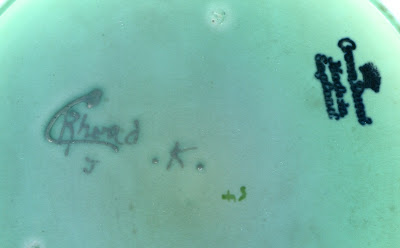
Charlotte Rhead Crown Ducal tube-lined base marks
Tube-lined .K. mark on a Persino pattern 3052 12" charger

Occasionally you may come across a tube-lined letter K with a dot either side, “.K.” on the base. The mark is obviously applied by the tube-lining artist at the time she signed her Rhead signature. There is evidence that it is a message to the enamellers, gilders and lustrers that the pot need to be decorated in a different way to usual. Bernard Bumpus records the K mark as a possible identifier for a tube-liner, but this would not make sense because it is usually accompanied by a known tube-liners mark and therefore must have another purpose.

The single mention of the “.K.” mark in the Crown Ducal pattern books is under the entry for the Green Chain pattern 4298 where there is a pencil notation, “To be marked .K.” I have recorded 7 examples from the original production run of pattern 4298, (AGR2 backstamp style), that have the “.K.” mark. The only other patterns seen to date with the “.K.” mark are Byzantine 2681, (24 examples) and Persino 3052, (13 examples) which are different colourways of the same design.

The possibility that the mark might be to alert the decorators to apply different colours is reasonable because in 1935 both orange and green versions of the Chain pattern, (4100 and 4298), would have been in production. The tube-lining was exactly the same for the two patterns, so instructions would have to be passed somehow as to what colours should be used to fulfil the required client orders.

Unfortunately the theory breaks down because, of the Byzantine/Persino pairing of “.K.” marked pieces the 25 Byzantine pots are decorated in traditional 2681 colours, not 3052 colours. Therefore if the mark was an instruction to the enamellers then the message was ignored most of the time!

This could be resolved by changing the the meaning of the ".K." mark to - ask the supervisor what colours to decorate the pot with because two versions are in production at present - that might work.

Whatever the precise meaning, the general idea still has merit because further study of the pattern books reveal that two other patterns have instructions that they should be marked in a specified manner. These are 4300 and 4318, which are variations of the Tudor Rose pattern. For pattern 4300, the instruction is “To be marked ".B.”, which makes sense as one of the dominant colours in the design is blue. Similarly for pattern 4318 the instruction is “To be marked .O.”, where the dominant colour is orange. It should be said that at the time of writing no examples of Tudor Rose have been seen with a tubelined “.B.” or “.O.”. Please let me know if you have one.

The tube-lined .S. mark

Charlotte Rhead Crown Ducal tube-lined base marks
Tube-lined S mark on a Lotus Leaves pattern 2682 bowl

The “.S.” mark is  more problematic, it can exist with or without the dot marks either side, there is no reference to it in the pattern books and it occurs on a wider range of patterns, sometimes with only a few observations, or a single example. Of the 38 examples seen it is most commonly found on the Lotus Leaves pattern, (2682), Rhodian, (3272) and Trellis, (6016). But also examples are known on patterns 2691, 2801, 3797, 4016, 4040, 5391, 5393, 5802, 5803, 6017 and rare unnumbered trial designs.

Some of these patterns exist in different colourways. For Lotus Leaves most of the ".S." marked items are the rarer green wash variation , (but not exclusively). Several other designs in the list above exist in different colourways, either with the same pattern number or a different one. There is a high proportion of variations to the true designs amongst the ".S." marked items but equally, in many cases it does not appear that the decorators modified the enamelling in any way.

First thoughts are that the ".S." represents an instruction for special colouring since the two colourways of Lotus Leaves are the earliest known colour variation of Charlotte’s Crown Ducal patterns. A single jug in the Turin, (2691) pattern without any enamels has been seen with an S mark.

The next occurrences of S are on Rhodian, (3272), but only one of the five examples has any variation of the design and that is in the green and blue colourway. After that, examples are scarce until the 5391 special blue/mauve mottle glaze pots, (also used for Iris & Floretta patterns). Then two examples on Fruit Border, (5802), only one of which appears different to type with a border motif more akin to Rhodian. There is one example on Palermo, (5803), which is a special variation of the design, (or the original prototype) with two rows of petals, and several on Trellis, (6016), none of which appear to exhibit any variation from type. 

The evidence is not very compelling, the suggestion that these marks were originally devised as codes for alternative colour decoration remains a possibility. Or perhaps the mark meant they were the "Samples" for the Crown Ducal travellers, (sales representatives) to take for showing to clients - but then the range of items seen would seem rather odd with several 2682, 3272 and 6016 but none or very few of the other patterns. It is also worth remembering that "Special" or "Sample" may not relate just to the pattern or a variation in the pattern, but could be about the shape. A handled vase in shape 198 exists in pattern 2801 with an ".S." mark and the AGR2 backstamp. It appears to be the standard Byzantine/Danube design, but this would not have been a new design when it was made. But the shape was new, it only went into production at the beginning of 1935, and so the "Sample" may have been to show off the new shape rather than the pattern itself.

It is probably best just to say it might mean that the pot is destined for a special purpose so that it might be decorated with extra care and be identified, retrieved and set aside at the end of the decorating process for whatever this special purpose might be.

Just to add to all the uncertainty in these matters, one item, (a smokers box in Stitch , 3274) is marked "SS" and a green washed Lotus Leaves jug with green wash is marked "SD". "Special Shape" and "Special Design"  - who knows?

Tube-lined shape numbers
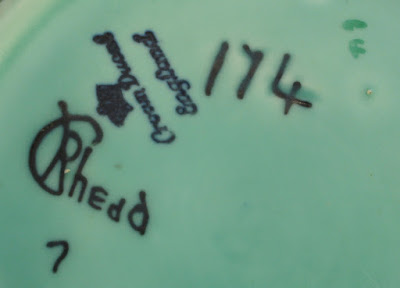
Charlotte Rhead Crown Ducal tube-lined base marks
Tube-lined shape number 174 on a  Primula pattern bowl

The shape number of is often tube-lined on the base of vases and some bowls, but this practice appears to have ceased sometime during 1936. It is not uncommon to find the early patterns and examples of Persian Rose, (4040), or Green Chain, (4298), with the feature but much less so on Tudor Rose, (4491) or Manchu, (4511). No design younger than Manchu has been observed with a shape number tube-lined on the base.

The new shapes that were introduced in 1936 like 209, 211, 212, 213 and 214 all had the shape number moulded within a recessed rectangle quite clearly in the base so that the glaze could not obscure the figures as was often the case with the inscribed shape numbers. It was probably at about this time that it was deemed unnecessary to tube-line the number as well.

This is quite a useful date marker but not a very precise one. Although the new shapes with moulded numbers are almost certainly the trigger to stop tube-lining shape numbers, it is impossible to say if the practice stopped because of a change in policy or it gradually ceased because it was becoming a wasted effort. My thoughts lean to the former scenario because I have only seen one pot from those shape numbers, 209-214, with a tube-lined shape number and that is a shape 209 with pattern 2801. A splendid vase produced late in the production period for the Danube pattern and may possibly have been a special order or one of the first trial pieces to show off the the new large vase shape 209.

Tube-lined pattern numbers
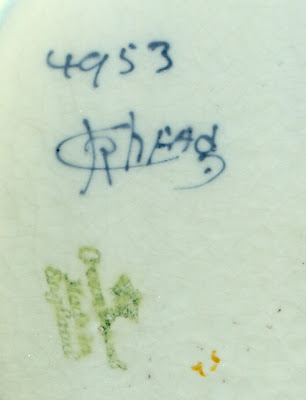
Charlotte Rhead Crown Ducal tube-lined base marks
Tube-lined pattern number 4953 on a Foxglove 12" charger

If shape numbers stopped being tube-lined in 1936 is is almost the opposite story for pattern numbers. In the early 1930s it appears that only slip decorated patterns had tube-lined pattern numbers. These would be the big salad bowls and platters for the USA market and the Blossom design on snow glaze, pattern 4538. If a pattern number is present on any other design it would have been applied by the enameller or lusterer.

Then sometime, in 1936, it becomes more likely that the pattern number is tube-lined for all designs. Certainly observations show that patterns 4921, 4922, 4924, 4926, 4953 and 4954 have a very high chance of having tube-lined pattern numbers. These would all have been promoted strongly at the British Industries Fair in March 1937 so perhaps it was decided with the great surge in orders that it was more efficient for the tube-liners to number the pots rather than the paintresses.

Triangles of 3 tube-lined dots

Charlotte Rhead Crown Ducal tube-lined base marks
Tube-lined 3 dot triangle mark on a Stitch pattern 3274 bowl

These are a fascinating curiosity. I have details of 16 items where there is a small triangle of 3 tube-lined dots on the base, 8 are on Byzantine, 2681, 1 on Lotus Leaves, 2682 and the remaining 7 on Stitch, 3274. The Byzantine and Lotus Leaves pots all have Charlotte's own signature on the base. So can we presume that the triangle of dots mean these pots are the work of Charlotte Rhead, and consequently that Charlotte even mucked in with tube-lining examples of the simple Stitch pattern herself? I believe there has to be a more involved explanation than that otherwise why sign and add the dots as well. 

And Others!

A couple of other marks have been seen. A single example of a tube-lined asterisk and two examples of the the letters ".N.M.". They do not appear to be decorated differently to type so there is not much  point in speculating their meaning.