Sunday, 11 March 2018

Period Advertising from New Zealand

The huge amount of scanned newspapers online is a boon for anyone researching the past. Recently I have been searching through the old newspapers of New Zealand and have found lots of fascinating advertisements for Crown Ducal and even a mention of Charlotte Rhead. This post presents some that are useful in helping with the Crown Ducal production history, they have illustrations, names or enough text description to identify patterns and of course the newspapers are dated.

Pattern 1479 Regent shaped tableware


The earliest advertisement I have selected is for pattern 1479 a coloured lithograph design dating to 1927. It was one of the earliest designs to use the Regent shape for tableware. As yet I have not discovered a pattern name for it but it seems to have been quite popular.

The Otago Daily Times 21st November 1928
Copyright owner is Allied Press Ltd
Pattern 1479 on Regent shaped plate

Pattern 2800 Aztec vase by Charlotte Rhead


It is lovely to see the Rhead attribution in this advertisement from the D.I.C. store in Dunedin showcasing items from the British Industries Fair of 1933. It hardly needs pointing out but there is a sketch of a pattern 2800, Aztec shape 152 vase. It is actually quite a rare pattern/shape combination. I have recorded only three such vases for sale during 20 years of observing these things. Perhaps they are all treasured in New Zealand homes.
The Otago Daily Times 16th September 1933
Copyright owner is Allied Press Ltd 

Aztec pattern 2800 on shape 152 vase


Tableware pattern like 2833 on Victory shape in different colours


I am reasonably confident I am on the right track with identifying this pattern. The sketch fits the pattern. The description of yellow border with black inner lines is close, but there is a good chance that the advertisement is describing pattern 2833 in different colours. Perhaps the inverse of the black and yellow example below, but instead with yellow semicircles and black inner band. The pattern number would precede the designs of the surviving pattern books so there is no reference source. It is just a matter of waiting until an example turns up.
The New Zealand Herald 11th July 1935
Copyright owner is NZ News & Media

Pattern 2833
Pattern like 2833 in different colours


Snow glaze coffee set - probably pattern 4626 Yukon


I do not have a picture of a coffee set but my best guess is that this advertisement would be for a coffee set in the Yukon pattern. The centre lithograph is the only contender for an "English posy design"

The Evening Post 7th February 1938
Copyright owner is Fairfax Media

 
Pattern 4626 Yukon


Nine different tableware patterns


One advertisement is a research project in itself. It is for James Smith's, the Wellington department store and has descriptions of 9 Crown Ducal tableware designs, most of which can be identified or at least reduced to a small choice of options.
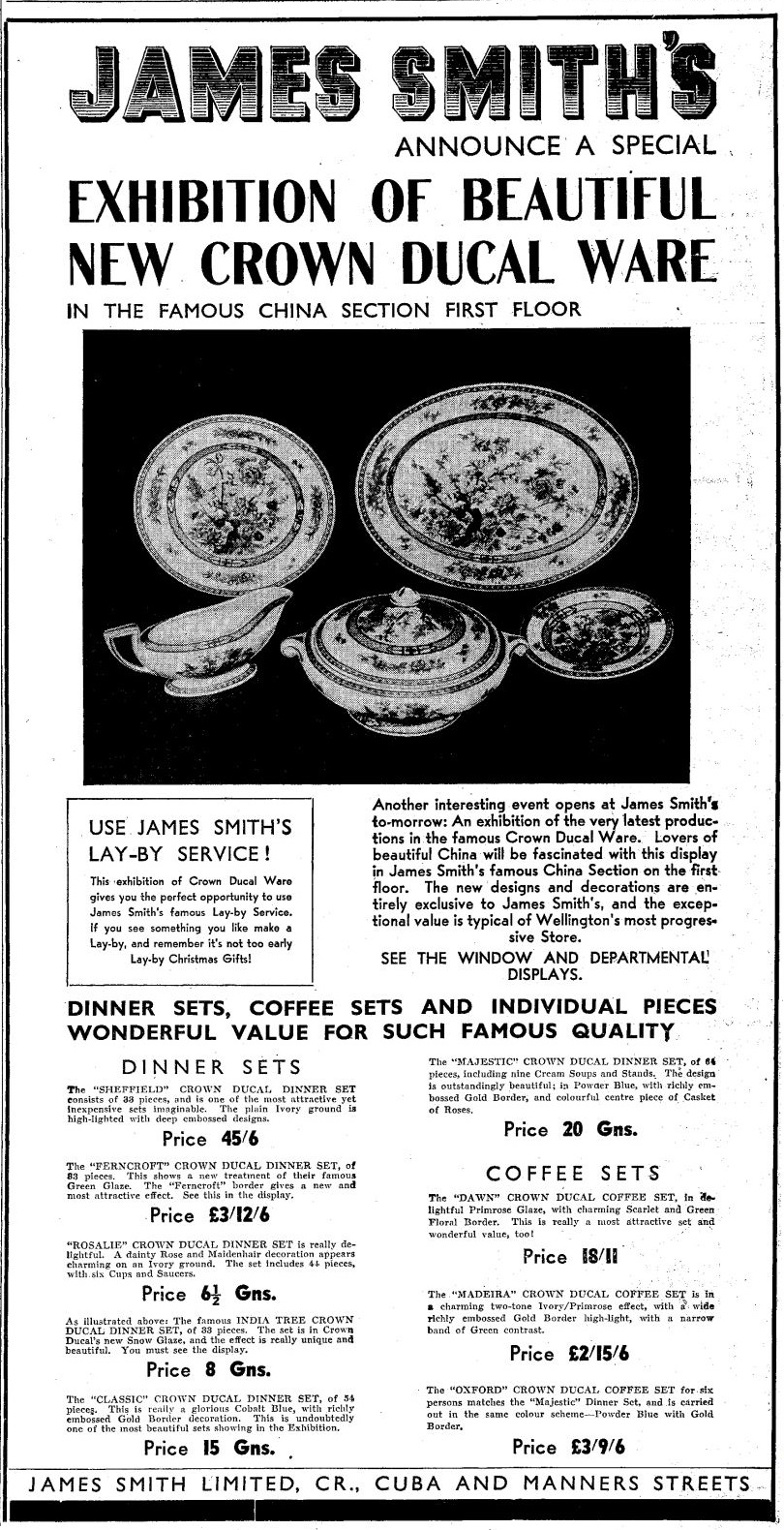
The Evening Post 23rd August 1938
Copyright owner is Fairfax Media
Taken in order:

"Sheffield" is the undecorated, ivory glazed Sheffield shaped embossed tableware. For those unfamiliar with the Sheffield shape have a look at the Winston Churchill plate - the last item in this post - which an example of a decorated Sheffield plate.

"Ferncroft" is probably pattern number 5196. Cotswold shape, green glaze with the Ferncroft lithograph border. The example illustrated is not part of a dinner set but the glaze, lithograph and pattern number are the same.
Pattern 5196

"Rosalie" is a well known long running pattern for which I have never found a pattern number. The Rosalie transfer is usually found on the Florentine embossed ivory tableware shape and with a gold edge. I have written about this pattern in a previous post. https://rhead-crownducal.blogspot.co.uk/2013/10/crown-ducal-period-advertising.html

"India Tree" lithograph pattern on Avon, Windsor and Ionic shapes with snow glaze is the one in the photograph. It is pattern number 4802.

Pattern 4802 large plate

"Classic" is a little trickier. I have not found this pattern name in Crown Ducal documents, but the description of  'cobalt blue with richly embossed gold border' reduces the options to probably either pattern 5055 "Admiral" or 5056 "Colfax". They are very similar, Avon shape with white glaze. Admiral has a gold inner line whereas Colfax has a gold paste printed inner border.
Patterns 5055 Admiral (top) and 5056 Colfax (bottom)

"Majestic" is another unfamiliar name, but the description, 'powder blue with richly embossed gold border and colourful centre piece of casket of roses", means it is either pattern 5080/81 or 5304. Again, they are very similar, Avon shape with white glaze, the floral centre is the Roma circular lithograph designed by William Johnson. The ambiguity over 5080/81is because 5080 meets the description in the pattern book with powder blue band whereas 5081 has powder pink band but all examples seen seem to have had 5081 on the base whatever the colour.  5080/81 has the powder blue colour extending to a large central lithograph, whereas 5304, has a narrower band and smaller central lithograph so that a large area of the plate is white glaze.
Pattern 5081

"Dawn" is also an unfamiliar name. I believe it may be pattern 5195, Cotswold shape, with yellow glaze and the Ludlow border lithograph. There were several patterns created using either the yellow or green glaze and having previously popular lithographic borders most of which include scarlet flowers and green leaves. The Ferncroft mentioned above is from this group of patterns. The picture below is the Ludlow border on ivory glaze to show the lithograph design. The way it might be used for "Dawn" is likely to be different with the border applied to the outside rim of the cups.

"Dawn" is probably the Ludlow border illustrated here but with yellow glaze


"Madeira" Is an as yet unidentified pattern. But I would propose that it might be pattern 5101 with a green band. The picture below is pattern 5101 with a blue band and is known as "Concord". Pattern 5102 is very similar but with a second gold paste band beneath the coloured stripe. Both patterns are recorded in the pattern book as having been made with green bands but I have yet to see an example.

Madeira may be like pattern 5101 but with a green band.

"Oxford" The Crown Ducal name Oxford is reserved for a maroon version of 5056 Colfax mentioned above under the "Classic" pattern notes. Since the advertisement suggests it matches the "Majestic" dinner service but without mention of the floral lithograph then the best match would be either the powder blue version of 5055 "Admiral" which would be named "Galway" or the the powder blue version of 5056 "Colfax" which would be "Ashley".

Pattern 5187 cake plate with pictorial print and enamel centre


This is one of  the many print and enamel centred cake plate designs that were produced for Gainsborough and Florentine embossed plates. They rarely appear in the UK but seem more common in New Zealand. This description forms part of another advertisement for the James Smith's store.

The Evening Post 25th August 1938
Copyright owner is Fairfax Media

Pattern 5187 on Gainsborough shape cake plate

Pattern 4794 Kashmere


It is an awful picture, but there is no doubt that there is a Charlotte Rhead tube-lined vase, shape 213, in the Kashmere pattern 4794 in this advertisement. The jug and other vase, (shape 212), are described as in autumn tonings but the image does not give a clue as what the patterns might be.

The Press 11th November 1938
Copyright owner is Fairfax Media
Kashmere pattern 4794 on shape 213 vase

Pattern 5540 Pansy chintz


From its earliest days Crown Ducal always had one or two chintz patterns on sale and the 1930s and 40s were no exception. The Pansy Chintz, pattern 5540 was introduced in 1938 and some variations of it with combined with gold floral prints either on the rim or in the centre became quite popular in New Zealand in the 1940s. This advertisement would be referring to the the original pattern.

Lake Wakatip Mail 11 July 1939
Pattern 5540 Pansy Chintz

Patterns 5800 and 5801 with Delamere print


Here we have another nicely illustrated print design with coloured washband. The Crown Ducal name for the print is Delamere, the name given to its first use pattern 5647. These later versions are named "Juliet" in green, (5800), and "Miranda" in fawn, (5801), on the Avon shape tableware. They were designed in early 1939 and so like some of the other lines it takes about a year for, the showcasing, ordering, manufacturing, distribution and local advertising to run its course.

The New Zealand Herald 7th March 1940
Copyright owner is NZ News & Media

Delamere print on Avon shaped tableware Juliet in green (5800) and Miranda in fawn (5801)


Pattern 6356 Winston Churchill cake plate with photographic print centre


The Winston Churchill plate is one of the last designs to be recorded in the pattern book before war time restrictions brought pottery decorating to a virtual standstill. The pattern number is 6356 and the last pattern entry is 6367. The printed image of Winston Churchill is believed to be created from a photograph taken by Cecil Beaton at 10 Downing Street on 20th November 1940. The embossed plate style comes from the Sheffield tableware range but examples can also be found on square plates from the Florentine tableware range.

The Otago Daily Times 3rd August 1942
Copyright owner is Allied Press Ltd 

Pattern 6356 Printed Churchill photograph on Sheffield shape plate

End note


There are plenty more Crown Ducal advertisements to document from this period, particularly yellow or green glazed tableware which seems to have been very popular. The difficulty is that a lot of it was not decorated with enamels or lithographs and the Crown Ducal pattern books are useless when it comes to recording these plainer designs. And, since they did not pass through the hands of enamelers there are no pattern numbers on the base. For example, there are advertisements for the salad or crinkle ware, Queen Anne shape and Cotswold shape in either yellow or green and stitched edge Cotswold tableware in these colours too. The only advertisements I am confident of linking with known numbered patterns are the yellow or green glaze Queen Anne and Cotswold shaped tableware with wide gold edge bands. These are patterns 5082, (green) and 5083, (yellow). The company appears to have used the same pattern number for both shapes.

Friday, 26 January 2018

Facsimile signatures. Part 2, Fanny Morrey

It is time to return to the subject of facsimile signature styles. It is more than 3 years since I started with the “easy ones” of Rose, Hannah and Elsie?

https://rhead-crownducal.blogspot.co.uk/2014/07/charlotte-rhead-facsimile-signatures.html

I believe my reasoning for what I wrote then still stands true. The statistics might have changed with more observations, but not in any significant way. Since then Gerrard Shaw has provided new information in his book on Crown Ducal Ware of 2015, with additional names and some employment dates. But with no links between these names and the pottery markings it has actually made my project harder!

My plan here is to significantly reduce the list of anonymous signature styles and ascribe several to Fanny Morrey in the hope that what is left will be easier to untangle.


Composite of proposed series of tube-lined marks by Fanny Morrey starting with the oldest at the top and the youngest at the bottom. The three forming a cross are styles from 1935-1936 which form a cluster where the sequence cannot be unravelled with confidence.
This constructed history of Fanny Morrey’s signature styles is all speculation. It is based on the premise that she changed her signature style throughout her time tube-lining Crown Ducal ware. The styles usually have similarities to the signature which is typically associated with the letter F and which collectors assume to be her mark.

For those who want the simple answer at the beginning, then Fanny Morrey tube-lined all items marked with an F, a DOT, or a 2, (except those 2's defined as being the work of Elsie Fearns? in the previous facsimile signature post).

These various styles also have to fit with information researched by Bumpus that Fanny was a very experienced tube-liner previously employed by Moorcroft and who may have joined Richardson’s sometime around 1933. Also, Shaw provides information that Fanny was with the company from 1932 until after WW2, but that she came with Charlotte from Burgess & Leigh. Although it would be good to know Fanny’s history prior to coming to Richardson’s it is not relevant to identifying her Crown Ducal work. It may well be that she worked at both Moorcroft and Burgess & Leigh; after all, Charlotte had worked at many potteries before 1932.


TL-FM5
Working backwards in time from her standard signature with the letter F it is important to note that this style, (TL-FM5), was not used until the patterns Tudor Rose, (4491), and Manchu, (4511), were well into their second year of production in 1937. Clearly, if Fanny joined the Crown Ducal team in 1932-33 there are going to be hundreds of examples her work with earlier designs and marked with different tubed base marks.

TL-FM4a, TM-FM4b, TL-FM4c left to right with 4a possibly the oldest and 4c the youngest.
So how did Fanny identify her work before her TL-FM5 mark?  There are several variations that are a cross between Charlotte’s own signature and Fanny’s. That is to say they all use the L for Lottie, but this collective group named TL-FM4, can have the letters E and A either both upper case or both lower case and the letter D can have the top horizontal line or not. In addition most are associated with the tube-lined number 2 rather than the letter F.

I have subdivided TL-FM4 based on their differences and think I have the sequence correct. However, it is a struggle to explain the distribution for all this diversity in how Fanny marked her work at this time. Perhaps future discoveries may require the sequence to be revised.

TL-FM3
One indisputable feature is that 66% of the pattern Orange Chain, (4100), items are marked with proposed versions of Fanny’s signature, and 50% are with the TL-FM3 style. For some reason she made this pattern her own. Pattern 4100 was designed at the end of 1934, so it would be reasonable to date that signature style to the end 1934 and early 1935.

Both Bernard Bumpus and Gerrard Shaw mention that Fanny Morrey was an already experienced tube-liner and that she came to work with Charlotte around 1932-33. This was a time when no Lottie Rhead signatures with an L instead of a C were applied, (except those by Charlotte herself). If Fanny joined in 1932-33 she must have used an alternative signature style, or styles, with a C for Charlotte.

TL-FM2
Fortunately there are two that fit the missing time period from the beginning of tube-lined production up to the end of 1934. The youngest pattern seen to date with the younger of these two styles is 4100. It does require a leap of faith to say that TL-FM2 and TL-FM3 are the marks of the same person. If one looks at the letters “h.e.a.d” of the TL-FM2 signature style and the lower case versions TL-FM4 and TL-FM5 they are as close a match as you could expect.

Importantly, the style of the number 2 is quite consistent amongst the different versions with a strong baseline, and is unlike the 2 used by Elsie Fearns?, which can often look like the number 7. In further support that this period 1 or early period 2 style, (TL-FM2), belongs to Fanny, is the observation that over 60% of Omar, (pattern 4036), items were tube-lined by this artist. It seems reasonable that one of the most complicated of Charlotte's designs would be tube-lined by a senior tube-liner. In fact Omar can be found with several different signature styles, (TL-FM2, TL-FM3, TL-FM4 or TL-FM5). My proposal for Fanny’s signature history means that she tube-lined them all. With this scheme I have yet to see an example of Omar tubed by anyone else.

Although the TL-FM2 signature exists on Byzantine examples from period 1, the earliest production period, there is a problem in that there are not enough period 1 examples. That is to say, Rose, Dora and Adams? were significantly more productive than Fanny based on only the TL-FM2 mark. If we are to believe Bumpus and Shaw that Fanny was there at the beginning we need yet another signature style to increase her work output from the earliest days.

TL-FM1
TL–FM1 is proposed as Fanny Morrey’s earliest signature style for Crown Ducal. The script is very similar to TL-FM2 but the C and the underline is more curved but it is usually accompanied with the characteristic number 2 mark. Adding together TL-FM1 and TL-FM2 production gets close to the period 1 output of Fanny’s colleagues. I believe her slightly lower productivity may be because she concentrated on the more complex designs and rarely worked on Lotus Leaves, Turin or Aztec.

TL-FM6
To end this story it is necessary to identify Fanny’s contribution after the WW2 restrictions on decorated pottery came into force in the summer of 1942 and after Charlotte herself had left the company. In his book, Gerrard Shaw notes that Fanny was working as a tube-liner after WW2, but there is no evidence that items marked with a tube-lined F were produced after the summer of 1942. If Fanny was tube-lining for Crown Ducal after Charlotte had left the company the only possibility is that she adopted the DOT mark which I will refer to as TL-FM6, instead of using F. There are no other marks that could signify her work. The other marks on post war items such as L, 11 and 111, are those that were in use by colleagues working while she was using the F mark.

Below are all of Fanny Morrey's observed output presented as histograms at the time of writing with the exception of unnumbered experimental designs. Also, items on small and awkward shapes are not included as these are difficult to fit into this chronology based on periods 1 to 6.  The history has been divided into two, one covering periods 1 and 2, and the other periods 3 to 6.You will probably need to click on them to open a larger version to make it legible.


Periods 1 & 2
Fanny Morrey's production history as observed until December 2017 grouped by backstamp defined period, facsimile signature style.

Periods 3, 4, 5 & 6
Fanny Morrey's production history as observed until December 2017 grouped by backstamp defined period, facsimile signature style.
Here is an attempt to date these different signature styles. It comes with my usual warning that they can only be a guide. There is no historical record of the tube-liners production history or their marks.

TL-FM1    Startup until early summer 1933
TL-FM2    Early summer 1933 until early 1935
TL-FM3    Early 1935 until late spring 1935
TL-FM4    Late spring 1935 until early 1937
TL-FM5    Early 1937 until mid 1942
TL-FM6    From mid 1942 onward, probably until mid-late 1950's

There are some loose ends to tidy up. There exist a few examples of Golden Leaves pattern 4921, with the period 2, AGR2 backstamp, unsigned but with a DOT mark. There are some Hydrangea table lamps, too awkward for any backstamp apart from the basic “MADE IN ENGLAND”, AGR8 style, also with DOT marks. These observations at first appear contrary to the rules of this proposed classification – suggesting there was a tube-liner “DOT” active in the mid 1930s. But I believe that this supports the case for the DOT mark to belong to Fanny Morrey as it links the post WW2 era to that of pre-WW2. With regard to the table lamps, there was no space for the signature, for Golden Leaves it may just have been pressure of work and a way to save time. In the scheme of things Fanny did not tube-line many items of Golden Leaves, so perhaps this is her venting her frustration at being sidelined from her usual task of working on the more difficult Florian, Carnation, Foxglove or Wisteria designs. The problem is easily solved by understanding that Fanny already had her abbreviated mark ready to use when needed and when the tube-liners were told to stop signing their work she reverted to using the DOT as she had used before.

I would like to suggest an explanation for the strange TL-FM3 style. It has capital letters E and A that interrupt the otherwise gradual evolution of Fanny’s signature. In fact it is a almost a copy of Charlotte's own signature, and the one that was used by the tube-liners at Burgess & Leigh. This may have been a problem for Charlotte. I propose that at some time around the introduction of pattern 4100 Fanny Morrey was given permission to sign L Rhead, (for Lottie Rhead), either as a symbol of seniority or friendship. However, this style TL-FM3 was so close to Charlotte's own signature that perhaps she was asked to modify it and after trying various options, which I have grouped as TL-FM4, it eventually stabilised as TL-FM5.

Another unusual sighting is that of a large salad bowl in pattern 3170, one of the USA designs drawn entirely in slip clay. It is the only example I have seen with the tubed mark 2 for Fanny without a signature. There are lots of pots with the F mark and no signature but only this one sighting of an unsigned earlier item of her work. These bowls would have been made when Fanny was using her TL-FM2 style, if it had been signed.

Also, I should mention that for statistical purposes in the histogram I include in the group TL-FM5, all the unsigned items that carry a tube-lined F mark as I assume they were made during the same time range as the signed items with an F mark.

I am hoping that the logic of all this does not come across as total fantasy. It seems to me to be a good way to reconcile the biographical research of Bernard Bumpus and Gerrard Shaw together with the observations of hundreds of base markings.

Monday, 13 November 2017

Charlotte Rhead - Pattern 4516 On TV

Just in case you missed it.  An opportunity to see a rare Crown Ducal charger on the BBC Bargain Hunt program. You can view with BBC iPlayer until about the 28th December 2017.

The program is Bargain Hunt Series 48: 19. Hungerford 11
https://www.bbc.co.uk/iplayer/episode/b09g695x/bargain-hunt-series-48-19-hungerford-11

For about 2 seconds at 39.15 minutes and seconds into the program you can see Charlotte Rhead's dragon design on a snow glaze 12" charger - pattern number 4516. There are some other glimpses of it throughout the auction scenes in the program. It is displayed on a stand sitting on a marble topped chest of drawers, (it is not one of the items being bought or sold for Bargain Hunt).

The design is recorded in the the Bumpus book "Collecting Rhead Pottery"  and in the Crown Ducal pattern books. But finding examples are very much in the hen's teeth category.

To save the effort of searching the film for a glimpse of the charger I have included a picture of it below. The decoration is tube-lining in black slip, enamels in dull black and dull scarlet and finished with bronze lustre and gold. On the reverse it has backstamp AGR2 and signature by Fanny Morrey. I would estimate the design and date of manufacture to be around the end of 1935 or very early 1936.

12" charger in pattern 4516
There are other images available on the net. Go to bigwoodauctioneers.com and visit their archive of completed auctions and look for lot 171 in the sale on 28 July 2017.

Sunday, 29 October 2017

Charlotte Rhead - Pattern 2799 Identified


It is always a joy to discover a new fragment of knowledge about Charlotte Rhead and her designs for Crown Ducal. Here is another piece of the jigsaw puzzle!

While browsing the lots at an auctioneers this week I came across a mixed lot of ceramics that included a bowl in what I call the “Running Water” pattern. I have mentioned this design in a previous posting, https://rhead-crownducal.blogspot.co.uk/2014/01/charlotte-rheads-design-sources-for.html and discussed its association with the Aztec pattern 2800. Below is the image used in that previous post with the same caption.

Charlotte Rhead Crown Ducal shape 148 unnumbered design with Running Water motif
The bowl at the auction was in a distressed state with chips and enamel losses, but the exciting thing was that it had a pattern number of 2799. Certainly one that is unrecorded in the Bumpus books and also absent from the surviving Crown Ducal pattern books which start at 2900 for Rhead era designs.

Charlotte Rhead Crown Ducal bowl pattern 2799 with Running Water motif
A pattern number of 2799 is perfect because being adjacent to 2800 for Aztec, and with the same colour palette helps confirm that they might come from the same design inspiration of native North American symbols.

Basemarks of pattern 2799 bowl
All the line work is tube-lined of course, but the stitches or dots on the rim are all worn of colour and relief so I think these were enamelled rather than tube-lined. The shape 148 vase, above, does not have rim stitches so it cannot be compared. I have recorded another shape 148 vase, but without handles featured in the Miller's Antiques guide of 1999. That had a black stitched edge, but the stitches do not appear to be raised so I am inclined to believe they are enamelled decoration.
An example of pattern 2799 from the Miller's Antiques Guide 1999 edition
The nice tube-lined signature is Charlotte's own rather than one of her decorating team. The backstamp style indicates the item was made pre-1935. This is correct for an item designed in the spring of 1933 and for a pattern that did not go into commercial production. There are tantalising paintress marks which appear to be the initials M.S. This is unusual because the paintresses invariably used numbers to identify their work.

Gerrard Shaw compiled a list of employees for his book on Crown Ducal, and in that list he has an enameller named Millicent Sanders who worked from 1928 until post war. I am hesitant to say this must be her work because I do not know of any precedent of identifying a named Crown Ducal paintress from base markings. But, there has to be a reasonable possibility for a connection. It reminds me of the title sequence of the Pottery Ladies TV film where after mentioning Miss Cliff, Miss Cooper, Miss Rhead, the title script ends with "AND ALL THE FORGOTTEN GIRLS....."


Friday, 7 July 2017

"Aztec" Inspired Tube-Lined Cotswold Tableware

Edited 5th December 2017

A tube-lined coffee cup and saucer came up for sale recently and I was unable to resist! I call this the "Aztec" tableware design simply because of the stepped line motif and the same little tubed rectangles that Charlotte Rhead used in her Aztec pattern 2800.

The design is simple but must have taken a lot of effort, much more so than the stitched edge tableware. I wonder if the tube-liners had to mark out the line lengths before applying the slip before tube-lining, or whether their practised eye meant the ends of the stepped line would always join up correctly. Not to mention all those fiddly small rectangles.

Group of "Aztec" tableware on Cotswold shapes

There are four versions of the design in the pattern books. The tube-lining with black slip is identical for all of them, they just differ in the colour decoration.

Pattern 3213 has scarlet and gold filled pairs of rectangles, gold edge and scarlet and black inner lines. Having the gold probably means this was the expensive version.

Detail of pattern 3213

Pattern 3219 has scarlet and orange filled pairs of rectangles, scarlet edge and scarlet and black inner lines.

Detail of pattern 3219
Teapot in pattern 3219
Many thanks to Carole for sending me a picture of her teapot in pattern 3219. Tableware with handles and knobs, particularly tureens and teapots, are the best for showing off the embellishments that add interest to Charlotte's designs.

Pattern 3220 has scarlet and orange filled pairs of rectangles, orange edge and orange and black inner lines. I have yet to see an example in this colourway.

Pattern 3223 has just the tube-lining and no coloured decoration.

Detail of pattern 3223

All the examples I have seen have AGR1 backstamp style which includes the Cotswold shape registration number. This style was used until about the end of 1934. The design date of these “Aztec” tableware patterns is estimated to be October 1933 and because examples are not common I doubt production continued for long.

Backstamp style found on these designs

In my notes for these designs I have recorded the observation that someone brought  a similar coffee cup and saucer in pattern 3223 shown above for Bernard Bumpus to comment on at the Charlotte Rhead Collectors Day on 30th July 2000. Since then, there have been very occasional examples for sale on Ebay. Some wide rimmed soup bowls and cream and sugar set in pattern 3213 and coffee pot in pattern 3219. So I am fairly sure there are more examples circulating or in peoples collections.

Saturday, 6 May 2017

Table Lamp Shapes (Update 2)

Returning again to the subject of Crown Ducal table lamps, here we have two discoveries, both without conventional pattern numbers but both are documented in the sample book held at the Stoke-on-Trent library.

Lamp pattern S.17 on shape 401


The first is a variation of Charlotte Rhead's chain patterns 4100 and 4298.

Pattern S.17 on table lamp shape 401

Detail at top of lamp


It is documented in the sample book as S.17 where the text reads:

S.17
Blue matt
Pattern as S.15
Coloured Silver & Goods Blue
Silver Bands
White Background

There are some rough pencil sketches and these are annotated where the silver lines are to go. The entry is written in pencil but there is the number 401 added in black ink, 401 is the shape number of this lamp. The information for S.15 is a sketch of a shape 208 vase with the text “Off White Matt Glaze Tubed in Dark Brown Lustred in Orange & Black Orange Bands” Everything about the sketch and the description tallies with what collectors know as pattern 4100, Orange Chain. 

This information in itself is quite interesting as I believe S.15 and 4100 are one of the few pattern pairings that link the sample book with the pattern book. I have recognised a few others, particularly tableware patterns where pattern numbers have been added to the sample book. If sufficient tie points could be found between the two books it could become a resource to help with design dating. There are fewer entries in the sample book and probably not in continuous use, but it does cover designs dated from 1935 until 1942.

Back to S.15, it must also help determine the date for the introduction of the 208 shape, which would be around the time of this entry, very early in 1935. I do not believe it can be earlier than 1935 because no example of a shape 208 vase has yet been seen with a period 1 backstamp and in a previous post I estimated the the period 1-2 boundary to be the end of 1934.


The original Crown Ducal label is still inside the lamp

Astonishingly the original factory hand written label is still inside the lamp with the inscription “Lamp 401 S17”, and in the typical habit of decorators labelling errors the facsimile signature of Fanny Morrey and the pattern mark of S.18.

A version of Fanny Morreys mark and an incorrect tube-lined S.18


Lamp pattern S.36 on shape “Bamboo” or E6


This lamp base was recently auctioned with online publicity. Again, it fits the sample book description perfectly.

Pattern S.36 on table lamp shape "Bamboo"or E6

The sample book entry reads:

S.36
New shape Bamboo
Fawn glaze. Full Strength
Mottled White
Orange Lustre Bamboo
2 green on leaves
Black centres

Fortunately there is a drawing of the “Bamboo” lamp shape in the pattern book for pattern 4133, (which has the same shape but is decorated differently), so we can be confident that the example in the picture does correspond to the S.36 description. The shape name in that document is referred to as E6. The design age of the Bamboo lamp, and 4133 will be around the same time as the S15, S17 and 4100 items above, that is early 1935.


Saturday, 4 March 2017

Tube-Lined Stitched Edged Tableware Designs

Pattern 3049 is the most easily found of the Crown Ducal “Stitched Edge” tableware designs. The February 1934 edition of the Pottery Gazette reported that:  

"Another new pattern that is sure to please, and which seems bound to result in solid business, is the "Stitch", a pattern which, though characterised by simplicity, has a strong power of appeal. This pattern, which is also depicted in the group photograph here reproduced, is offered in three different colourings, and at a very moderate price. It consists of a rather intriguing manipulation in tube-lining under the glaze, and is applied to the new "Cotswold" shape, which conveys the impression of pottery that is produced on the wheel by means of throwing and turning." 

The photograph from this article is shown below.

Stitched Edge (3049) Cotswold tableware on the right. Also shown are either Rialto (3140) or Belfast (3154) on the left and Daffodil (3234) in the centre.
Below are a few newspaper advertisements from around the world which would support the idea that the tube-lined stitched edge tableware was a commercial success.

Stitched Edge Cotswold tableware advert in a USA newspaper, The Binghamton Press of 27 March 1934.

Stitched Edge Cotswold tableware advert in a Canadian newspaper, The Montreal Gazette of 25 January 1934.

Stitched Edge Cotswold tableware advert in an Australian newspaper, The Adelaide Advertiser of 18 October 1935

Pattern 2864 is is believed to be the earliest recorded tube-lined tableware design for Crown Ducal by Charlotte Rhead. No examples have a pattern number on them, nor does a pattern book exist with this number. However, the evidence comes from the entry for pattern 3168 where the design for the large, black stitched edged trays and salad bowls is recorded. The number 3168 is crossed out and a note “Use 2864” written beside it. A similar note is beside entry 3167 which is the alternating black and orange large stitched edge design which says “Use 3049”. Pattern 3049 is present in the pattern book as the equivalent black and orange stitched edge Cotswold tableware, therefore it is reasonable to assign 2864 to the black slip version.

This suggests that the Cotswold tableware range were the original stitched edged designs. A little later, the much larger stitches on the "USA" salad bowls and trays were given different pattern numbers but by the time production had begun all shapes with the same colour stitches had the same original pattern numbers.

The third stitched edge slip colour often found is matt blue for which the pattern number is unrecorded. But 3171 is the number for blue stitch on the large salad bowls and trays, so that is the number I use based on the principle used in the pattern book for the other colour versions.

Pattern 2864 stitched edge design in black slip on Cotswold shape coffee duo

Pattern 3049 stitched edge design in orange and black slip on Cotswold shape trio

Pattern 3049 stitched edge design in orange and black slip on Cotswold tray or 17" charger and its base markings
Pattern 3171 stitched edge design in matt blue slip on Cotswold shape coffee duo

One interesting discovery from this research is that the orange and black, 3049, pattern is clearly given a name in the pattern book, but is difficult to read. Bernard Bumpus must have had the same problem because he scoured the books for pattern names but never put this one in his books. Below is an image of the name. My interpretation of it is "Niva" For a while I struggled to make sense of this until an internet search found out it is a girls name that may have been more popular in the early 20th century than today.

The pattern name for 3049 is Niva?
Examples of pattern 3049, Niva, tableware have been seen with an extra backstamp "EXCLUSIVE TO HARRODS KNIGHTSBRIDGE LONDON, S.W.1." which would have been a useful endorsement of the design. Another observation is that some items have the AGR3 backstamp style indicating they were produced in the mid 1950s after the WWII restrictions of decorated pottery were lifted and indeed after Charlottes death.

Before leaving the plain stitched edge Cotswold tableware of 1933, the other colourways should be recorded. None of which have been seen to date.
3048 Orange slip (Not yet seen)
3050 Crimson slip (Not yet seen)
3051 Alternating black and crimson slips (Not yet seen)

Pattern 3122 is a development of the plain black stitched edge Cotswold tableware (2864). In the pattern book there are three possible colour schemes for the enamelled printed centre, but two have been crossed out, possibly at different times. The floral design is printed in black and then enamelled either in yellow, orange and two greens which is the surviving version in the book, or yellow, fawn, crimson, peach and blue. The third version is similar to the first in greens, yellow and brown but with higher contrasting colours

Two colour variations of pattern 3122
One has to speculate as to whether or not this is Charlotte's first foray into print design. Crown Ducal was enjoying the success of the print and enamel Sunburst design and perhaps this is Charlotte's attempt at combining the current fashion for simple colourful floral prints with her trademark tube-lining. Certainly it is a  pleasing design and was quite successful since examples appear for sale quite frequently, especially in the USA.

Charlotte was busy in the summer of 1933 with her tableware designs. Again, using the black stitched edge format she created her nurseryware series.

Nurseryware series 3130-3135
The patterns are:
3130 The maid was in the garden
3131 Who said dinner?
3132 Is it carrots?
3133 Little Boy Blue
3134 Tom the pipers son
3135 Red Riding Hood

Several other nursery ware designs were made that do not have pattern numbers, these may have been samples or commissions. But "Who's afraid of the big bad wolf?" and "Polly put the kettle on" appear occasionally and so these designs probably went into production too.

A study of the backstamp styles suggests that patterns 3131, 3133 and 3135 continued to be produced while Charlotte remained at Richardsons and for patterns 3131 and 3133 continued after she had left. Little Boy Blue has been seen with the AGR4 backstamp style which probably means they were still being made in the 1960’s. This makes Little Boy Blue her longest running pattern in production, almost thirty years.

It is interesting to note that the number of  Little Boy Blue and Who said dinner? items made during the the WWII restrictions period of 1942-1952 greatly exceeds the total nurseryware production  made outwith this period. Perhaps about a quarter of these have been found outside the UK in the usual Crown Ducal export markets. But even so, is it possible that the nurseryware was exempt from the restrictions on the public being able to buy decorated pottery? Or just the result of a consumer requirement caused by the post war 1946 baby boom!?

The next group of pattern numbers are those that introduce the "USA salad bowl and tray" designs. The trays are usually displayed as large wall chargers because the base rim is pierced for a hanging wire. They were clearly designed for the USA market, where most examples have been recorded, and quite possibly at the request of Richardson's agents in New York, Maddock & Miller. Bernard Bumpus quotes in his book from an advertisement for the company that mentions that there are twelve decorations stocked and the advertisement included a picture of the Blossom pattern. I have not been able to track down the reference yet and without any further information it is difficult to identify the twelve specific designs. Also it is not clear if all the designs were tube-lined, and if one includes the enamelled designs produced on these shapes and the tube-lined trailing laurel leaf border designs as well, then it is easy to exceed 12 decorations.

The designs with large stitched edges are:
3167 Alternating black and orange slips (Use 3049)
3168 Black slip (Use 2864)
3169 Alternating black and orange slips with fruit tree centre
3170 Alternating black and orange slips with dragon centre
3171 Matt blue slip
3172 Alternating matt blue and Danube blue slips with fruit tree centre. Tree trunks are Danube blue, leaves and pebbles are matt blue and the apples are in salmon slip.

Pattern 3172
3173 Cotswold shape matt blue slip stitch on top of plate instead of over edge. (Not yet seen)
3221 Alternating matt blue and Danube blue slips with bird centre. (Not yet seen)
3257 Alternating matt blue and Danube blue slips with Blossom centre.
3258 Alternating black and orange slips with Blossom centre
3259 Alternating black and orange slips with  fruit tree centre (Use 3169)

Up to this point most of the tube-lined tableware designs will be familiar to collectors, either from examples seen or from reading "Collecting Rhead Pottery" by Bernard Bumpus. But we have hardly started. Charlotte continued to design more and more tube-lined tableware designs. Mostly for the Cotswold tableware shape, but also a lot for the Queen Anne shape that was popular in the USA, and to a much lesser extent patterns were made for the No 3, Florentine, Avon, Windsor and Regent ranges. Almost all of these are as yet unseen and I would be surprised if many went into proper production.

I will limit these notes to designs with either the simple or large tube-lined stitched edge. The first is a beautiful piece of tube-lining design on a tableware plate, although it is impossible to imagine it being used as tableware, it must have lived in the china cabinet.

3260 named "Florentine" (not to be confused with the Florentine tableware shape range!), which is also the name of the centre design which is similar to the Blossom centre design. There is a trailing twin stem border in the verge. The shape range is not specified, but the sketch of the rim is not perfectly round so it will be one of the moulded tableware ranges with gently scalloped plate rims. I am quite sure it is the No3 shape range as it has moulded dentilled edges which can accommodate the modified shape slip stitches. There is also a design detail for covered dish handles so it has to be a tableware shape range and not fancies or salad bowls and trays. The stitches are tube-lined slip covering the dentilled moulding of the plate.

Pattern 3260 Florentine, the stitches overlay the dentilled moulding of the No3 shaped plate.

3261 Alternating matt blue and Danube blue stitched edge "Grindley Hotel". A rather ambiguous description but since Grindley Hotel Ware was made by another pottery company, was this perhaps to be a joint venture with Richardsons applying  tube-lining to Grindleys hard wearing vitreous china for the hotel and restaurant market. (Not yet seen)

3262 Shape range No3 which is the heavily embossed tableware range with fruit trees and various fruiting and flowering plants on the plate shoulders. (See picture above of pattern 3260 which is on No3 shape). Trailing twin stem border in the verge and alternate stitched edge decorated in alternating black and orange slip and Blossom centre.This pattern is not properly illustrated but my best guess is that this is the same as 3260 except in different colours and with Blossom centre rather than Florentine centre. (Not yet seen)

3288 Alternating matt blue and Danube blue large stitched edge and dark, (Danube?), blue edge line, Blossom centre on the "New Large Punch Bowl" This is another ambiguous description that appears to be the same as 3257 but with a blue edge line. However the "New Large Punch Bowl" reference implies a different shape and I wonder if this is a reference to the giant 17" diameter bowls which are known to exist from an example of pattern 3191, the sailing ship design. (Not yet seen)

3347 Trailing twin stem border in the verge and alternate stitched edge decorated in alternating black and scarlet slip. Shape range not specified but the sketch it for the square plate with scalloped edges which may be the Regent range. (Not yet seen)

3370 A drawing but no description! Essentially as 3260, alternating matt blue and Danube blue stitched edge, trailing twin stem border in the verge, and Florentine centre. But, tableware shape looks to be round with scalloped edges, (Regent?), and is adjacent to other tableware designs with yellow glaze instead of the usual ivory and the sketch is shaded yellow like those. (Not yet seen)

3375 Essentially as 3260, alternating matt blue and Danube blue stitched edge, trailing twin stem border in the verge, but with Blossom centre. Round tableware shape shape with scalloped edges, but explicitly noted as No3 shape. (Not yet seen)

3376 Trailing twin stem border in the verge and alternate stitched edge decorated in alternating matt blue and Danube blue slips, no centre design. Cotswold shape range. (Not yet seen)

A mysterious group of four patterns, two colours and the words "Big Stitch". No drawings or other description or the ware to apply it to, but I presume them to be tube-lined  because Danube and Matt Blue are slip colours.
3407 Brown & Orange Big Stitch. (Not yet seen)
3408 Black & Orange Big Stitch. (Not yet seen)
3409 Brown & Green Big Stitch. (Not yet seen)
3410 Danube & Matt Blue Big Stitch. (Not yet seen)

3432 Simple green stitched edge on Cotswold. The description does not specify tube-lining, so I use pattern 4108 instead which appears to be exactly the same but does specify tube-lining.

3473 As 3376 only under yellow glaze. (Not yet seen)

3536 An extraordinarily complex tube-lined design on Cotswold shape. Imagine pattern 3376 with the addition of stitched spokes radiating across the plate shoulder from the trailing twin stem border in the verge. Within each segment, (bounded on three sides by stitched lines and one side by the stem border), there is a stem of laurel leaves. They have the same shape as those in the post Rhead era designs for patterns 6568, 6570 & 6571 but are tube-lined in the two blue colours of slip. (Not yet seen)

3537 The same as 3536 but tube-lined in orange and black slips. I have tried to draw the layout of patterns 3536 and 3537 below. (Not yet seen)

A sketch of the coloured slip design for patterns 3536 and 3537 on Cotswold tableware

The next design does not explicitly state tube-lining, but appears so similar to a previous pattern that it may be tube-lined.

3635 as 3376, trailing twin stem border in the verge and alternate stitched edge decorated in alternating green and black, no centre design. Cotswold shape range. (Not yet seen)

3853 as 3049 stitched edge decorated in alternating orange and black on Florentine shaped tableware and with tube-lined decorated handles. (Not yet seen)

4108 Back to the simplest and earliest stitched edge designs. Here we have green slip on Cotswold shape.
Pattern 4108 stitched edge design in green slip on Cotswold shaped sugar bowl

5027 Blue slip sponged solid face with tube-lined white slip stitched edge. (Not yet seen)

5485 Tube-lined blue stitched edge, two blue stitches alternating with one gold painted stitch.Tube-lining under white glaze. Probably Avon and Windsor shaped tableware. Also gold and blue slip decoration on handles and gold line work. (Not yet seen)

5694 Green slip stitched edge on Cotswold shape with yellow glaze. A fairly popular recycling of the design especially for export, with most examples seen in New Zealand.

Patter 5694 stitched edge design in green slip with yellow glaze

5950 Blue slip stitched edge on Cotswold shape with pink glaze. (Not yet seen)

More patterns will no doubt come to light, but collectors should be aware that there are a very large number of stitched edge Crown Ducal designs and many of them are applied with lustres or enamels. If you find an unusual stitched edge design do not assume it is tube-lined. Touch is the best way to determine if slip was used because the decoration will feel raised.