Monday, 11 March 2019

Arcadian Glazes, Dripware & Mottled Glazes


I recently came across a Crown Ducal dripware glazed vase. Although I do not collect these I usually look closely to see if I can find an example that matches the descriptions in the Crown Ducal pattern books. The glaze on this one matched the description and picture for Glaze No. 84.

The vase will date to 1940/1942 because it has the AGR7 type backstamp but the style is a reprise of the Arcadian Glazes range from Crown Ducal in 1929.

I have not found any pattern numbers for the Arcadian Glazes and later dripware productions of the 1930s & 1940s and so they are quite difficult to catalogue. But there are 11 pages in one of the Crown Ducal pattern books that document “Mottled Glazes Etc.” from Nos. 10 to 95. The notes for each glaze vary from nil to a brief description specifying glaze names and method of application. There are a few watercolour sketches for some of the glazes and this is where I was lucky with my purchase as it is one of the few illustrated ones.

Below are images of the vase and also a picture file of the transcribed list of “Mottled Glazes” from the Crown Ducal pattern book. You will probably need to save the list image in order to read it. The first column is the pattern book glaze number. The second column is whether or not there is small water colour sketch of the design. The description is my best attempt to try and transcribe the pencil annotations.

Crown Ducal Arcadian Glaze dripware
Glaze No. 84 on a shape 173 vase


List of mottled glazes as transcribed from Crown Ducal pattern book


Back to the beginning of the story, the ‘Arcadian Glazes’ range of dripware from Crown Ducal was introduced in the October 1929 edition of the Pottery Gazette.

The typically verbose and enthusiastic writing about the ware begins as follows:

"A. G. Richardson & Co.,, Ltd., Gordon Pottery, Tunstall, whose new London showroom at 46, Holborn Viaduct, E. C. 1, in control of Green Bros. & Edis, is now open, replete with a full range of the company’s appealing productions in all departments, have brought out quite recently a really admirable series of broken and variegated glaze effects in harmonious colourings, to be known under the name of “Arcadian Glazes.” On the production of lines such as these, as an adjunct to their staple trade in useful and decorative tablewares, the firm in question are to be warmly congratulated, for although the new art glazed wares are of a high order, portraying characteristics which exemplify sound technique, the prices at which they are being offered to the trade are unquestionably reasonable. We think we are justified in emphasising the fact that the new decorations, although they are undoubtedly the result of playful manipulations of colour amalgams, are in no sense to be regarded as “amateurish”; nor are they likely to prove of an ephemeral order, for they are distinctive and dignified, and worthy of being allotted a leading place in the display of any good-class china shop."

The article goes on at some length in the same vein with the only significant point of interest being that the Arcadian Glazes are likely to be good sellers for the 1929 Christmas trade, beyond and for the overseas market too. The image from the Pottery Gazette is reproduced below.


Crown Ducal Arcadian Glaze dripware
The "Arcadian Glazes" from the Pottery Gazette

Below is an illustrated advertisement from The Sphere newspaper of 1932. It is part of a larger feature advertisement for Crown Ducal being sold at the Harrods department store. It is helpful that the shapes can be identified and that the prices are included.

Crown Ducal Arcadian Glaze dripware
Arcadian Glazes being promoted at Harrods in The Sphere of 9 November 1932

Because I have no collection of Arcadian glazed pots I will use images found from searching the net. I hope the owner of these two pictures does not mind me reusing them, they clearly have a collecting passion for the subject.


Arcadian Glazes

If you have been able to save and view the list of mottled glazes you will find that vases 3 & 6, (from the left) on the bottom row in the picture above are most likely to be Glaze No. 13 (Blue 6336 & Flame 1180).

Arcadian Glazes
Likewise vases 3 & 4, (from the left) on the top row in the picture above are most likely to be Glaze No. 19 (Flame 1180 & Green 6444).

Those are two easy ones but after that it becomes quite hard to link decoration with text which is rather ambiguous. To pursue this as a project one would need to incorporate known information from the main pattern books, where very occasionally these mottled glaze numbers are used in the description of individual patterns.

These are ones that I have found:

Glaze 60 used for pattern 4964
A freehand enamelled fancy, illustrated as a jug vase in shape 226/227/228/X8 style. The design is the inverted border of Charlotte's Arabian scroll pattern with green spout, bands and handle, scarlet and orange arches and blue circles. The vase rims are dashed and a row of Charlotte's painted stitches below the lower band.

Glaze 61 used for pattern 4963
A freehand enamelled fancy, illustrated as a jug vase in shape 245. Like above. The design is the inverted border of Charlotte's Arabian scroll pattern with blue bands and handles, puce and orange arches and pink and orange circles. The vase rims are dashed and a row of Charlotte's painted stitches below the lower band.

Glaze 62 used for pattern 4962
A freehand enamelled fancy, illustrated as a jug vase in shape X20 style. Like above. The design is the inverted border of Charlotte's Arabian scroll pattern with orange spout and handles, green bands, blue and orange arches and green and scarlet circles. The vase rims are dashed and a row of Charlotte's painted stitches below the lower band.

Glaze 64 used for pattern 5650
A difficult to find tube-lined design by Charlotte Rhead which in the past I have called "Abstract Trellis" but I may need to rename it as the phrase "Tube Lined Check" occurs both in the numbered pattern book and the glaze pattern book. The description for Glaze 65 where the green only occurs as the inside rinse, or the base of chargers more accurately describes the known examples of pattern 5650. Of the few examples I have seen, none had green on the outside or face of the design. As an aside, the designer of The Bowes Museum display catalogue, (2018) chose the charger centre of pattern 5650 for the front cover. Maybe not typical Charlotte Rhead style but definitely striking!

Charlotte Rhead Crown Ducal glaze pattern 5650
Glaze 65
Glaze 72 used for pattern 6063
A freehand enamelled fancy, illustrated as a vase in shape 133/129 style. The design is of a small branch with  green leaves turning orange-brown.

Glaze 72 used for pattern 6189
The popular tube-lined design by Charlotte Rhead No. 6189 "Mexican".

Glaze 72 used for pattern 6198
Another tube-lined design by Charlotte Rhead No. 6198 "Basket". 

Glaze 78 used for pattern 5981
A print and enamel design almost certainly by Charlotte Rhead  for fancies "Floretta". A colourful glaze that Charlotte tried to use with tube-lined designs. The most notable being the "Iris" charger but also with a variation of the "Persian Leaf/Taragona" patterns. I have discussed the use of this glaze in a previous post. https://rhead-crownducal.blogspot.com/2013/08/charlotte-rhead-iris-charger.html

Interestingly, the only example I know of pattern 5650, with the pattern number on the base, which should use glaze 64 or 65 is in fact decorated with Glaze 78.

Charlotte Rhead Crown Ducal mottled glaze
Various items that use Glaze 78

Glaze 79 used for pattern 5982
Another tube-lined design by Charlotte Rhead No. 5982 "Circular Fruits".

Glaze 83 used for pattern 6068
A freehand enamelled fancy, illustrated as a vase in shape 133/129 style. The design is of  a flock of flying birds in a V formation with cloud outlines behind.

Since the glazes are not illustrated in the main pattern books the above descriptions are only of much use when an example has been seen. So glazes 64, 65, 72, 78 & 79 are the only ones from that source that can be positively identified.

It would be good to find out more about this subject and create a definitive record of Crown Ducal glazes but I fear much of the information may be lost. Perhaps someone who understands ceramic glazes better than I, and has a collection of Crown Ducal Arcadian glazes can marry up what they see with the glaze list above.


Saturday, 27 October 2018

The Bowes Museum - Summer 2018


The Charlotte Rhead: Between Art and Industry display at The Bowes Museum has now been dismantled and the items safely returned home. Sad that it is over, but we have been most fortunate in being able to show off part of our collection to a wider audience especially in such a prestigious location. We say a very big thank you to The Bowes Museum for hosting the display and in particular, Howard Coutts, Keeper of Ceramics, who was instrumental in making it all happen and to Catherine Dickinson and Vincent Shawcross for presenting it so beautifully.

We would also like to thank Howard for encouraging Ian to give a short talk on collecting Charlotte Rhead pottery to the Northern Ceramics Society at their meeting on June 20th in The Bowes Museum. It did feel like gate crashing a 17th to 19th century ceramics party but hope a little 20th century content provided an interesting distraction.

In addition, it was most enjoyable being able to produce the booklet to accompany the event and that will always be a fine souvenir of the display. Many thanks to the team at Curious12 in Bishop Auckland and we have no hesitation in recommending them to those searching for help with a design and print project. They exceeded our expectations with their imaginative design flair, advice on printing format and amiable patience with all the proof reading niggles.

All that remains is to show some pictures of the display especially for Charlotte Rhead enthusiasts who were unable to visit Barnard Castle this summer.

Ian & Margaret

PS  It is only by chance, but the display cabinet being adjacent to the Jacques Gruber stained glass panel is quite striking. The similarities of line and colour between Charlotte’s pottery and Gruber’s leaded glass of a decade earlier, (c.1925) is quite remarkable.

Charlotte Rhead Bowes Museum Exhibition Wisteria Foxglove
Charlotte Rhead Bowes Museum Exhibition
Charlotte Rhead Bowes Museum Exhibition chargers
Charlotte Rhead Bowes Museum Exhibition Stitch
Charlotte Rhead Bowes Museum Exhibition tableware Cotswold

The Bowes Museum links


Booklet preview link & Curious 12


Tuesday, 7 August 2018

Tube-lined base markings other than signatures and tube-liner identifiers

Collectors of Charlotte's tube-lined designs from Crown Ducal may have noticed items where the tube-liner has added numbers, letters or marks other than a Rhead signature or tube-liner identifying mark to the base.

These fall into five categories:
  • Production instructions - tube-lined .K. and .S. marks (and similar)
  • Tube-lined shape numbers
  • Tube-lined pattern numbers
  • Triangles of 3 tube-lined dots
  • And others!

All of these markings must have had a purpose at the time they were applied. Sometimes the purpose is clear such as the pattern number, but it may not be evident why the pattern number was tube-lined on some items and not others. This post is a summary of my thoughts so far on what can be read into these "additional" markings.

The tube-lined .K. mark

Charlotte Rhead Crown Ducal tube-lined base marks
Tube-lined .K. mark on a Persino pattern 3052 12" charger

Occasionally you may come across a tube-lined letter K with a dot either side, “.K.” on the base. The mark is obviously applied by the tube-lining artist at the time she signed her Rhead signature. There is evidence that it is a message to the enamellers, gilders and lustrers that the pot need to be decorated in a different way to usual. Bernard Bumpus records the K mark as a possible identifier for a tube-liner, but this would not make sense because it is usually accompanied by a known tube-liners mark and therefore must have another purpose.

The single mention of the “.K.” mark in the Crown Ducal pattern books is under the entry for the Green Chain pattern 4298 where there is a pencil notation, “To be marked .K.” I have recorded 7 examples from the original production run of pattern 4298, (AGR2 backstamp style), that have the “.K.” mark. The only other patterns seen to date with the “.K.” mark are Byzantine 2681, (24 examples) and Persino 3052, (13 examples) which are different colourways of the same design.

The possibility that the mark might be to alert the decorators to apply different colours is reasonable because in 1935 both orange and green versions of the Chain pattern, (4100 and 4298), would have been in production. The tube-lining was exactly the same for the two patterns, so instructions would have to be passed somehow as to what colours should be used to fulfil the required client orders.

Unfortunately the theory breaks down because, of the Byzantine/Persino pairing of “.K.” marked pieces the 25 Byzantine pots are decorated in traditional 2681 colours, not 3052 colours. Therefore if the mark was an instruction to the enamellers then the message was ignored most of the time!

This could be resolved by changing the the meaning of the ".K." mark to - ask the supervisor what colours to decorate the pot with because two versions are in production at present - that might work.

Whatever the precise meaning, the general idea still has merit because further study of the pattern books reveal that two other patterns have instructions that they should be marked in a specified manner. These are 4300 and 4318, which are variations of the Tudor Rose pattern. For pattern 4300, the instruction is “To be marked ".B.”, which makes sense as one of the dominant colours in the design is blue. Similarly for pattern 4318 the instruction is “To be marked .O.”, where the dominant colour is orange. It should be said that at the time of writing no examples of Tudor Rose have been seen with a tubelined “.B.” or “.O.”. Please let me know if you have one.

The tube-lined .S. mark

Charlotte Rhead Crown Ducal tube-lined base marks
Tube-lined S mark on a Lotus Leaves pattern 2682 bowl

The “.S.” mark is  more problematic, it can exist with or without the dot marks either side, there is no reference to it in the pattern books and it occurs on a wider range of patterns, sometimes with only a few observations, or a single example. Of the 38 examples seen it is most commonly found on the Lotus Leaves pattern, (2682), Rhodian, (3272) and Trellis, (6016). But also examples are known on patterns 2691, 2801, 3797, 4016, 4040, 5391, 5393, 5802, 5803, 6017 and rare unnumbered trial designs.

Some of these patterns exist in different colourways. For Lotus Leaves most of the ".S." marked items are the rarer green wash variation , (but not exclusively). Several other designs in the list above exist in different colourways, either with the same pattern number or a different one. There is a high proportion of variations to the true designs amongst the ".S." marked items but equally, in many cases it does not appear that the decorators modified the enamelling in any way.

First thoughts are that the ".S." represents an instruction for special colouring since the two colourways of Lotus Leaves are the earliest known colour variation of Charlotte’s Crown Ducal patterns. A single jug in the Turin, (2691) pattern without any enamels has been seen with an S mark.

The next occurrences of S are on Rhodian, (3272), but only one of the five examples has any variation of the design and that is in the green and blue colourway. After that, examples are scarce until the 5391 special blue/mauve mottle glaze pots, (also used for Iris & Floretta patterns). Then two examples on Fruit Border, (5802), only one of which appears different to type with a border motif more akin to Rhodian. There is one example on Palermo, (5803), which is a special variation of the design, (or the original prototype) with two rows of petals, and several on Trellis, (6016), none of which appear to exhibit any variation from type. 

The evidence is not very compelling, the suggestion that these marks were originally devised as codes for alternative colour decoration remains a possibility. Or perhaps the mark meant they were the "Samples" for the Crown Ducal travellers, (sales representatives) to take for showing to clients - but then the range of items seen would seem rather odd with several 2682, 3272 and 6016 but none or very few of the other patterns. It is also worth remembering that "Special" or "Sample" may not relate just to the pattern or a variation in the pattern, but could be about the shape. A handled vase in shape 198 exists in pattern 2801 with an ".S." mark and the AGR2 backstamp. It appears to be the standard Byzantine/Danube design, but this would not have been a new design when it was made. But the shape was new, it only went into production at the beginning of 1935, and so the "Sample" may have been to show off the new shape rather than the pattern itself.

It is probably best just to say it might mean that the pot is destined for a special purpose so that it might be decorated with extra care and be identified, retrieved and set aside at the end of the decorating process for whatever this special purpose might be.

Just to add to all the uncertainty in these matters, one item, (a smokers box in Stitch , 3274) is marked "SS" and a green washed Lotus Leaves jug with green wash is marked "SD". "Special Shape" and "Special Design"  - who knows?

Tube-lined shape numbers

Charlotte Rhead Crown Ducal tube-lined base marks
Tube-lined shape number 174 on a  Primula pattern bowl

The shape number of is often tube-lined on the base of vases and some bowls, but this practice appears to have ceased sometime during 1936. It is not uncommon to find the early patterns and examples of Persian Rose, (4040), or Green Chain, (4298), with the feature but much less so on Tudor Rose, (4491) or Manchu, (4511). No design younger than Manchu has been observed with a shape number tube-lined on the base.

The new shapes that were introduced in 1936 like 209, 211, 212, 213 and 214 all had the shape number moulded within a recessed rectangle quite clearly in the base so that the glaze could not obscure the figures as was often the case with the inscribed shape numbers. It was probably at about this time that it was deemed unnecessary to tube-line the number as well.

This is quite a useful date marker but not a very precise one. Although the new shapes with moulded numbers are almost certainly the trigger to stop tube-lining shape numbers, it is impossible to say if the practice stopped because of a change in policy or it gradually ceased because it was becoming a wasted effort. My thoughts lean to the former scenario because I have only seen one pot from those shape numbers, 209-214, with a tube-lined shape number and that is a shape 209 with pattern 2801. A splendid vase produced late in the production period for the Danube pattern and may possibly have been a special order or one of the first trial pieces to show off the the new large vase shape 209.

Tube-lined pattern numbers

Charlotte Rhead Crown Ducal tube-lined base marks
Tube-lined pattern number 4953 on a Foxglove 12" charger

If shape numbers stopped being tube-lined in 1936 is is almost the opposite story for pattern numbers. In the early 1930s it appears that only slip decorated patterns had tube-lined pattern numbers. These would be the big salad bowls and platters for the USA market and the Blossom design on snow glaze, pattern 4538. If a pattern number is present on any other design it would have been applied by the enameller or lusterer.

Then sometime, in 1936, it becomes more likely that the pattern number is tube-lined for all designs. Certainly observations show that patterns 4921, 4922, 4924, 4926, 4953 and 4954 have a very high chance of having tube-lined pattern numbers. These would all have been promoted strongly at the British Industries Fair in March 1937 so perhaps it was decided with the great surge in orders that it was more efficient for the tube-liners to number the pots rather than the paintresses.

Triangles of 3 tube-lined dots

Charlotte Rhead Crown Ducal tube-lined base marks
Tube-lined 3 dot triangle mark on a Stitch pattern 3274 bowl

These are a fascinating curiosity. I have details of 16 items where there is a small triangle of 3 tube-lined dots on the base, 8 are on Byzantine, 2681, 1 on Lotus Leaves, 2682 and the remaining 7 on Stitch, 3274. The Byzantine and Lotus Leaves pots all have Charlotte's own signature on the base. So can we presume that the triangle of dots mean these pots are the work of Charlotte Rhead, and consequently that Charlotte even mucked in with tube-lining examples of the simple Stitch pattern herself? I believe there has to be a more involved explanation than that otherwise why sign and add the dots as well. 

And Others!

A couple of other marks have been seen. A single example of a tube-lined asterisk and two examples of the the letters ".N.M.". They do not appear to be decorated differently to type so there is not much  point in speculating their meaning.

Monday, 21 May 2018

Charlotte Rhead: Between Art & Industry


Charlotte Rhead: Between Art & Industry
May 26th - September 9th
The Bowes Museum, Barnard Castle

It is less than a week to go and the excitement is building!

This morning the display cabinet was empty, ready and waiting to receive the Charlotte Rhead tube-lined pottery.

Thank you so much to Catherine and Vin, they have done a wonderful job designing and refining the layout to present the pottery at its best.


Charlotte Rhead Crown Ducal Bowes Museum exhibition

Charlotte Rhead Crown Ducal Bowes Museum exhibition

Sunday, 11 March 2018

Period Advertising from New Zealand

The huge amount of scanned newspapers online is a boon for anyone researching the past. Recently I have been searching through the old newspapers of New Zealand and have found lots of fascinating advertisements for Crown Ducal and even a mention of Charlotte Rhead. This post presents some that are useful in helping with the Crown Ducal production history, they have illustrations, names or enough text description to identify patterns and of course the newspapers are dated.

Pattern 1479 Regent shaped tableware


The earliest advertisement I have selected is for pattern 1479 a coloured lithograph design dating to 1927. It was one of the earliest designs to use the Regent shape for tableware. As yet I have not discovered a pattern name for it but it seems to have been quite popular.

The Otago Daily Times 21st November 1928
Copyright owner is Allied Press Ltd
Pattern 1479 on Regent shaped plate

Pattern 2800 Aztec vase by Charlotte Rhead


It is lovely to see the Rhead attribution in this advertisement from the D.I.C. store in Dunedin showcasing items from the British Industries Fair of 1933. It hardly needs pointing out but there is a sketch of a pattern 2800, Aztec shape 152 vase. It is actually quite a rare pattern/shape combination. I have recorded only three such vases for sale during 20 years of observing these things. Perhaps they are all treasured in New Zealand homes.
The Otago Daily Times 16th September 1933
Copyright owner is Allied Press Ltd 

Aztec pattern 2800 on shape 152 vase


Tableware pattern like 2833 on Victory shape in different colours


I am reasonably confident I am on the right track with identifying this pattern. The sketch fits the pattern. The description of yellow border with black inner lines is close, but there is a good chance that the advertisement is describing pattern 2833 in different colours. Perhaps the inverse of the black and yellow example below, but instead with yellow semicircles and black inner band. The pattern number would precede the designs of the surviving pattern books so there is no reference source. It is just a matter of waiting until an example turns up.
The New Zealand Herald 11th July 1935
Copyright owner is NZ News & Media

Pattern 2833
Pattern like 2833 in different colours


Snow glaze coffee set - probably pattern 4626 Yukon


I do not have a picture of a coffee set but my best guess is that this advertisement would be for a coffee set in the Yukon pattern. The centre lithograph is the only contender for an "English posy design"

The Evening Post 7th February 1938
Copyright owner is Fairfax Media

 
Pattern 4626 Yukon


Nine different tableware patterns


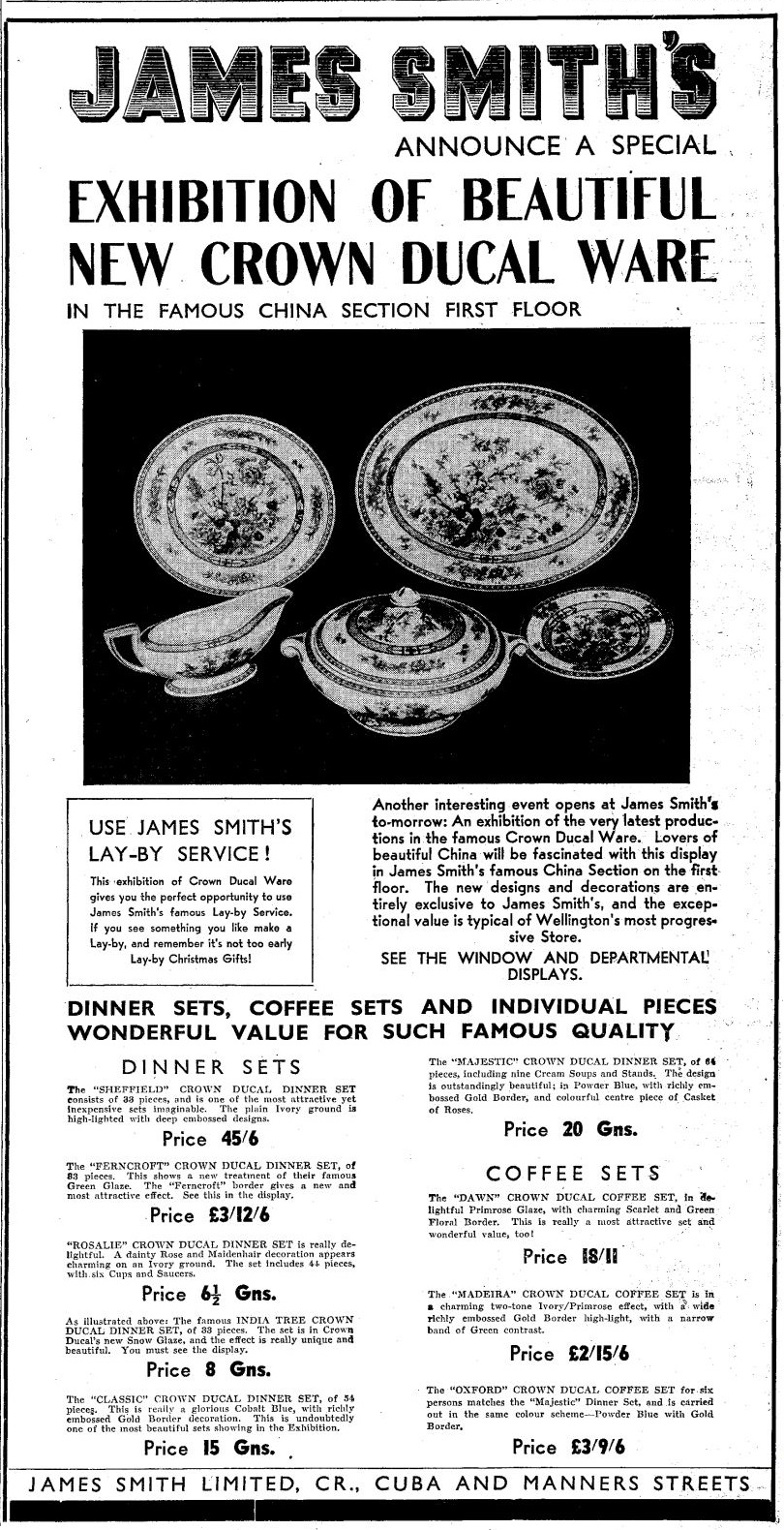
One advertisement is a research project in itself. It is for James Smith's, the Wellington department store and has descriptions of 9 Crown Ducal tableware designs, most of which can be identified or at least reduced to a small choice of options.

The Evening Post 23rd August 1938
Copyright owner is Fairfax Media
Taken in order:

"Sheffield" is the undecorated, ivory glazed Sheffield shaped embossed tableware. For those unfamiliar with the Sheffield shape have a look at the Winston Churchill plate - the last item in this post - which an example of a decorated Sheffield plate.

"Ferncroft" is probably pattern number 5196. Cotswold shape, green glaze with the Ferncroft lithograph border. The example illustrated is not part of a dinner set but the glaze, lithograph and pattern number are the same.
Pattern 5196

"Rosalie" is a well known long running pattern for which I have never found a pattern number. The Rosalie transfer is usually found on the Florentine embossed ivory tableware shape and with a gold edge. I have written about this pattern in a previous post. https://rhead-crownducal.blogspot.co.uk/2013/10/crown-ducal-period-advertising.html

"India Tree" lithograph pattern on Avon, Windsor and Ionic shapes with snow glaze is the one in the photograph. It is pattern number 4802.

Pattern 4802 large plate

"Classic" is a little trickier. I have not found this pattern name in Crown Ducal documents, but the description of  'cobalt blue with richly embossed gold border' reduces the options to probably either pattern 5055 "Admiral" or 5056 "Colfax". They are very similar, Avon shape with white glaze. Admiral has a gold inner line whereas Colfax has a gold paste printed inner border.
Patterns 5055 Admiral (top) and 5056 Colfax (bottom)

"Majestic" is another unfamiliar name, but the description, 'powder blue with richly embossed gold border and colourful centre piece of casket of roses", means it is either pattern 5080/81 or 5304. Again, they are very similar, Avon shape with white glaze, the floral centre is the Roma circular lithograph designed by William Johnson. The ambiguity over 5080/81is because 5080 meets the description in the pattern book with powder blue band whereas 5081 has powder pink band but all examples seen seem to have had 5081 on the base whatever the colour.  5080/81 has the powder blue colour extending to a large central lithograph, whereas 5304, has a narrower band and smaller central lithograph so that a large area of the plate is white glaze.
Pattern 5081

"Dawn" is also an unfamiliar name. I believe it may be pattern 5195, Cotswold shape, with yellow glaze and the Ludlow border lithograph. There were several patterns created using either the yellow or green glaze and having previously popular lithographic borders most of which include scarlet flowers and green leaves. The Ferncroft mentioned above is from this group of patterns. The picture below is the Ludlow border on ivory glaze to show the lithograph design. The way it might be used for "Dawn" is likely to be different with the border applied to the outside rim of the cups.

"Dawn" is probably the Ludlow border illustrated here but with yellow glaze


"Madeira" Is an as yet unidentified pattern. But I would propose that it might be pattern 5101 with a green band. The picture below is pattern 5101 with a blue band and is known as "Concord". Pattern 5102 is very similar but with a second gold paste band beneath the coloured stripe. Both patterns are recorded in the pattern book as having been made with green bands but I have yet to see an example.

Madeira may be like pattern 5101 but with a green band.

"Oxford" The Crown Ducal name Oxford is reserved for a maroon version of 5056 Colfax mentioned above under the "Classic" pattern notes. Since the advertisement suggests it matches the "Majestic" dinner service but without mention of the floral lithograph then the best match would be either the powder blue version of 5055 "Admiral" which would be named "Galway" or the the powder blue version of 5056 "Colfax" which would be "Ashley".

Pattern 5187 cake plate with pictorial print and enamel centre


This is one of  the many print and enamel centred cake plate designs that were produced for Gainsborough and Florentine embossed plates. They rarely appear in the UK but seem more common in New Zealand. This description forms part of another advertisement for the James Smith's store.

The Evening Post 25th August 1938
Copyright owner is Fairfax Media

Pattern 5187 on Gainsborough shape cake plate

Pattern 4794 Kashmere


It is an awful picture, but there is no doubt that there is a Charlotte Rhead tube-lined vase, shape 213, in the Kashmere pattern 4794 in this advertisement. The jug and other vase, (shape 212), are described as in autumn tonings but the image does not give a clue as what the patterns might be.

The Press 11th November 1938
Copyright owner is Fairfax Media
Kashmere pattern 4794 on shape 213 vase

Pattern 5540 Pansy chintz


From its earliest days Crown Ducal always had one or two chintz patterns on sale and the 1930s and 40s were no exception. The Pansy Chintz, pattern 5540 was introduced in 1938 and some variations of it with combined with gold floral prints either on the rim or in the centre became quite popular in New Zealand in the 1940s. This advertisement would be referring to the the original pattern.

Lake Wakatip Mail 11 July 1939
Pattern 5540 Pansy Chintz

Patterns 5800 and 5801 with Delamere print


Here we have another nicely illustrated print design with coloured washband. The Crown Ducal name for the print is Delamere, the name given to its first use pattern 5647. These later versions are named "Juliet" in green, (5800), and "Miranda" in fawn, (5801), on the Avon shape tableware. They were designed in early 1939 and so like some of the other lines it takes about a year for, the showcasing, ordering, manufacturing, distribution and local advertising to run its course.

The New Zealand Herald 7th March 1940
Copyright owner is NZ News & Media

Delamere print on Avon shaped tableware Juliet in green (5800) and Miranda in fawn (5801)


Pattern 6356 Winston Churchill cake plate with photographic print centre


The Winston Churchill plate is one of the last designs to be recorded in the pattern book before war time restrictions brought pottery decorating to a virtual standstill. The pattern number is 6356 and the last pattern entry is 6367. The printed image of Winston Churchill is believed to be created from a photograph taken by Cecil Beaton at 10 Downing Street on 20th November 1940. The embossed plate style comes from the Sheffield tableware range but examples can also be found on square plates from the Florentine tableware range.

The Otago Daily Times 3rd August 1942
Copyright owner is Allied Press Ltd 

Pattern 6356 Printed Churchill photograph on Sheffield shape plate

End note


There are plenty more Crown Ducal advertisements to document from this period, particularly yellow or green glazed tableware which seems to have been very popular. The difficulty is that a lot of it was not decorated with enamels or lithographs and the Crown Ducal pattern books are useless when it comes to recording these plainer designs. And, since they did not pass through the hands of enamelers there are no pattern numbers on the base. For example, there are advertisements for the salad or crinkle ware, Queen Anne shape and Cotswold shape in either yellow or green and stitched edge Cotswold tableware in these colours too. The only advertisements I am confident of linking with known numbered patterns are the yellow or green glaze Queen Anne and Cotswold shaped tableware with wide gold edge bands. These are patterns 5082, (green) and 5083, (yellow). The company appears to have used the same pattern number for both shapes.